SUOHPATJÁVRINorsk
Clouds and evening light reflected in Suohpatjávri

A lake full of life

A small lake on the Finnmark plateau. A vast landscape of knowledge, memories and light.

Discover the lake

More beneath
the surface

Suohpatjávri lies south of Guovdageaidnu–Kautokeino. Beneath its quiet surface, fish and their habitats interact in ways that have drawn the interest of researchers. Along the shore, nature meets trails, place names and Sámi cultural history.

2 km²Surface area
325 m a.s.l.Elevation
25 mMaximum depth

Lake data reported by Häkli et al. (2018), Table 1. See sources.

Research

The many lives of whitefish

Suohpatjávri offers researchers a place to study how fish adapt to different parts of the same lake.

A study involving researchers from UiT analysed 82 whitefish from Suohpatjávri. The sample included three forms: densely rakered (DR), large sparsely rakered (LSR), and small sparsely rakered (SSR) whitefish. They differed in gill-raker number; the researchers also examined body size and genetic differences.

Gill rakers are structures on the inner side of the gill arches that help retain food. Differences in these structures give researchers clues about how fish use food resources.

Read the 2018 research article ↗
DR

Densely rakered whitefish

An average of 40.7 gill rakers in the Suohpatjávri sample. 33 fish were examined.

LSR

Large sparsely rakered whitefish

An average of 28.2 gill rakers in the sample. 34 fish were examined.

SSR

Small sparsely rakered whitefish

An average of 23.7 gill rakers in the sample. 15 fish were examined.

Figures from Häkli et al. (2018), Table 2. The names refer to ecological forms of whitefish; the measurements describe the study sample.

An ecological archive beneath the surface. A UiT master’s thesis also examined eye parasites in whitefish caught in Suohpatjávri during fieldwork in September and October 2016. Both the fish and the organisms living on them can offer insights into the lake’s ecology. Read the thesis ↗

Research overview

Several paths of research

Suohpatjávri has been used in several studies addressing different questions with different methods. This selection complements the 2018 whitefish study and the master’s thesis described above. These are publications and datasets; several works may belong to the same project or use material from the same field collection.

2012

Whitefish over eleven years

Samples from Suohpatjávri collected in 1996 and 2007 were used to examine whether gill-raker distributions changed over time. No statistically significant change was found in sparsely rakered whitefish. In densely rakered whitefish, the median increased from 39 to 40 gill rakers. The study adds a long-term perspective on whitefish variation in the lake.

Siwertsson, Knudsen & Amundsen · Advances in Limnology · DOI 10.1127/advlim/63/2012/229

Read the publication ↗
2019 / 2020

Can differences in spawning time separate whitefish forms?

UiT researchers examined reproductive maturation in three whitefish forms, including material collected in Suohpatjávri in 2016. Differences in relative gonad weight suggested differences in spawning time. This supports spawning time as a possible contributor to reproductive separation, although different spawning grounds also need investigation. The article appeared online in 2019 and in the journal’s 2020 volume.

Bitz-Thorsen, Häkli, Bhat & Præbel · Ecology of Freshwater Fish · DOI 10.1111/eff.12486

Read the publication ↗ Open the 2016 research data ↗
2022

Food, competition and ecological niches

Suohpatjávri is included in a study of the feeding niche of large sparsely rakered whitefish. Researchers combined stomach contents, stable isotopes and survey fishing to examine links between resource use, body size, other fish species and lake conditions. Material from Suohpatjávri was collected in 2007. This study also provides the published species list used on this website.

Eloranta et al. · Journal of Animal Ecology · DOI 10.1111/1365-2656.13611

Read the publication ↗
2024

Whitefish parasites have an evolutionary history too

An international team including UiT researchers examined the genetics of the tapeworm Proteocephalus fallax in whitefish. In Suohpatjávri, parasites from littoral and pelagic whitefish showed weak but statistically significant genetic differentiation. The findings connect parasite variation with host ecology and reveal another layer of biological diversity in the lake.

Brabec et al. · Evolution Letters · DOI 10.1093/evlett/qrae025

Read the publication ↗
Life in the lake

Fish of Suohpatjávri

This overview of fish in Suohpatjávri combines research literature and local knowledge. Eloranta et al. (2022) list six species, with whitefish identified as the most abundant in the study. Brown trout has been added based on local information.

The research overview is based on material from 2007. It presents the study’s species list, supplemented by local knowledge of brown trout. It is not a new population survey.

See the species list in the research article, Table 1 ↗
European whitefish
Coregonus lavaretus
European perch
Perca fluviatilis
Northern pike
Esox lucius
Burbot
Lota lota
Arctic charr
Salvelinus alpinus
European minnow
Phoxinus phoxinus
Brown trout
Salmo trutta
Local information
History and culture

A landscape
with stories

Suohpatjávri is a Northern Sámi name. The Norwegian Mapping Authority records it as the lake’s principal name, with its official spelling adopted on 9 March 1993. The place name connects the lake with the language and the surrounding landscape.

Guovdageainnu Meahcceguovddáš documents the start of an existing nature trail at Suohpatjávri and work on the Márkanbálggis nature and culture trail. Here, knowledge of nature is connected with stories about the area.

A 2008 report by the Norwegian Institute for Cultural Heritage Research (NIKU) also discusses cultural history by the lake in connection with the nature and culture trail. It reminds us that stories are part of cultural heritage and that sharing them calls for respect for the significance of these places.

Read about the nature and culture trail ↗
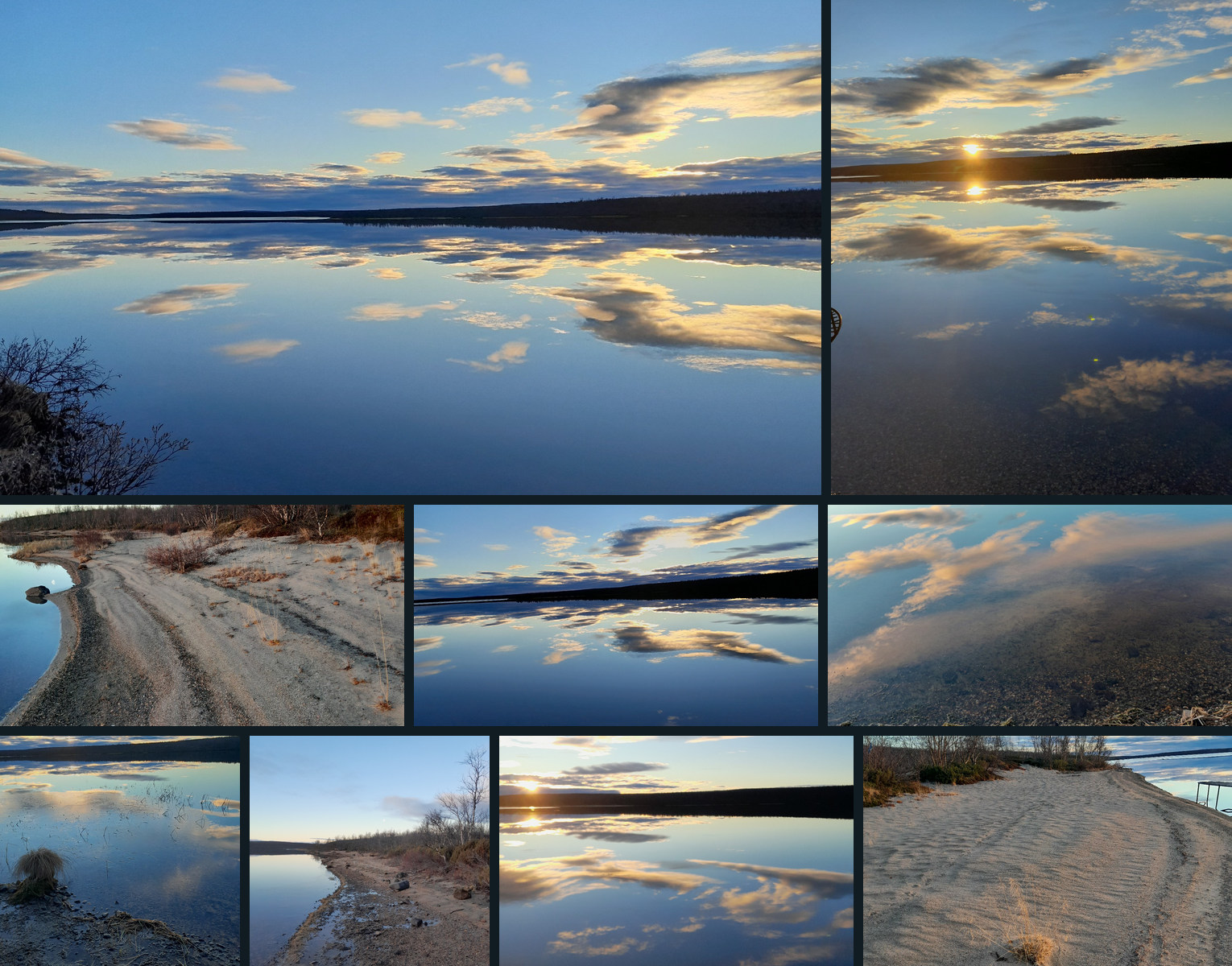
Sunlight reflected in the lake beside the forest
Evening light and reflections from the photo collection.
1993

The Norwegian Mapping Authority adopts the spelling Suohpatjávri.

2016

Fieldwork on the lake provides material for a UiT thesis.

2018

A research article describes three forms of whitefish from the lake.

Gallery

Light over the lake

Reflections, shorelines and quiet moments at Suohpatjávri. Select a photograph to open the photo collection.

Watch the light move

A short film from the “Light over the lake” collection lets the landscape tell its story at its own pace.

Sources

Further reading

The facts and research presented here come from the publications and organisations below. The research summaries on this page focus on Suohpatjávri.

  1. Eloranta et al. (2022): Fish communities and ecological niches ↗Journal of Animal Ecology · DOI 10.1111/1365-2656.13611. Species list for Suohpatjávri in Table 1.
  2. Häkli et al. (2018): Whitefish gill rakers and body size ↗Ecology and Evolution · DOI 10.1002/ece3.3876. Lake data and whitefish forms examined in Suohpatjávri.
  3. UiT: Master’s thesis on eye parasites in whitefish ↗Munin, UiT’s open research archive. Field material from Suohpatjávri collected in 2016.
  4. Norwegian Mapping Authority: Suohpatjávri ↗Official spelling, municipality and coordinates in Norway’s Central Place Name Register.
  5. Guovdageainnu Meahcceguovddáš: Nature and culture trail ↗Documentation of the nature trail beside the lake and plans for Márkanbálggis.
  6. NIKU Report 24 (2008): Sámi sacred sites ↗Cultural history and considerations when sharing knowledge. Suohpatjávri is discussed on page 45.

Suohpatjávri · Guovdageaidnu–Kautokeino
68.93917° N · 23.08861° E

Find the lake on the map ↗
Photo collection with nine views of the lake, sky and shoreline at Suohpatjávri

Light over the lake — photographs from Suohpatjávri.